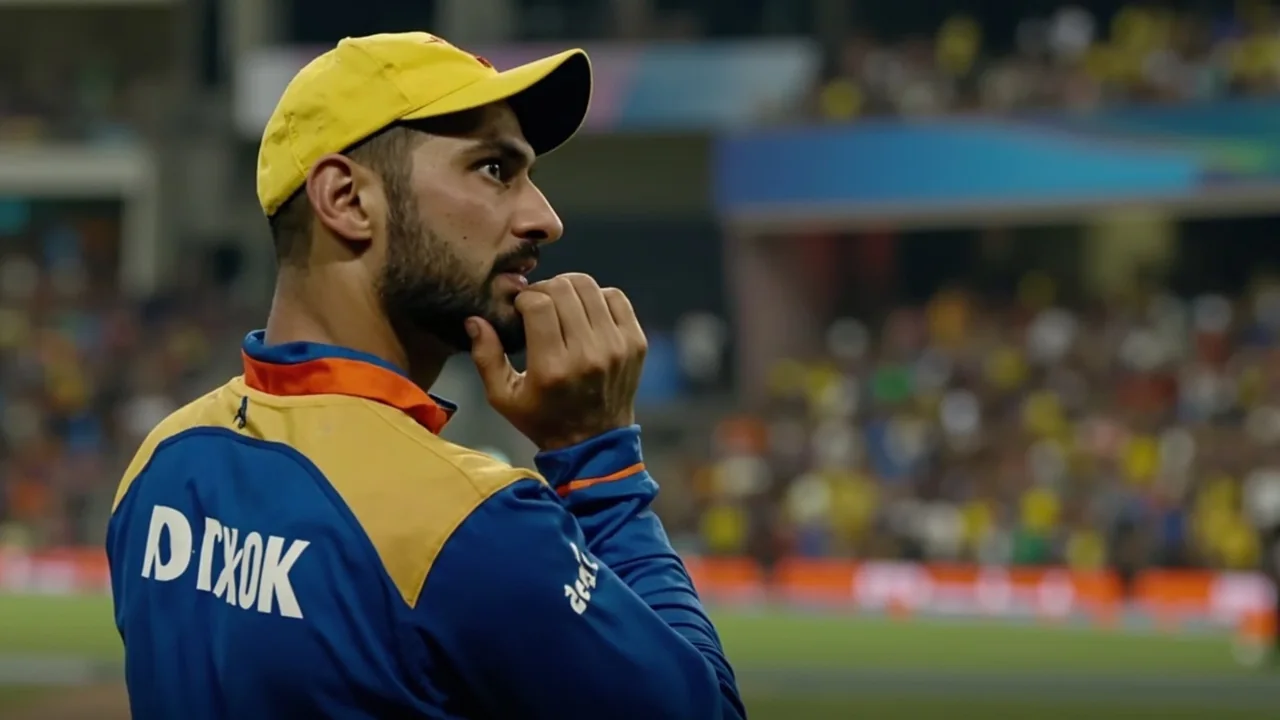
What Omkar Walnuj's ICR model actually projected
The prediction that put CSK back in the headlines on the eve of the 2026 launch came from Omkar Walnuj, an X cricket analyst, through his Integrated Contextual Rating (ICR) model. ICR is built around three inputs: venue difficulty, role-specific baselines for batters and bowlers, and a match-impact score that rewards finishing work in high-leverage overs. The model does not look at the auction table, the team balance sheet or the dressing-room mood. It looks at what each player has actually done in his role, on this kind of surface, against this kind of attack, and weights the finishing moments more heavily than the steady ones.
For the 2026 season, ICR projected a playoff four of Punjab Kings, Mumbai Indians, Lucknow Super Giants and Royal Challengers Bengaluru. CSK was placed tenth with a projected 12 points and a 46.23 per cent win rate. That placed the side below every other franchise, including Delhi Capitals, who were chasing a maiden title, and Rajasthan Royals, who were working back from a transitional window.
The model's 2025 track record is the reason the read has weight. ICR correctly named three of the four 2025 playoff teams before the season. The miss was the qualifier slot — ICR put Punjab Kings eighth on 12 points, the side actually finished fourth and reached the final. CSK, by contrast, finished tenth in 2025 with a 4-10 record and 8 points, a finish two spots and four points worse than the model's pre-season call of 14 points in eighth. The under-projection is the part that made the 2026 read land harder.
The injury pile-up the model could not see
Two of the three Australian names on the CSK roster were already unavailable before the launch. The model runs on the player as a role-unit; it does not run on whether the player is in the dressing room.
Nathan Ellis, the Australian fast bowler signed as overseas cover, will miss the entire 2026 IPL season with a hamstring injury. His only 2025 appearance ended with figures of 1 for 38 from four overs at an economy of 9.50 — a single match in which neither the wicket nor the economy shaped the conversation the way the franchise would have wanted. A bowler signed to lead the death overs cannot lead them from the medical room.
Matthew Short, the Australian all-rounder CSK bought at the 2026 auction for 1.50 crore (about $221,391 Canadian), will miss the start of the campaign with a fractured thumb. Short was one of 29 overseas players sold at the 2026 auction, a window in which franchises spent heavily on all-rounders precisely because the role is the most efficient way to balance an IPL XI. CSK bought Short for that balance, and Short will not be available for the opening exchanges.
Read those two absences against the model's read, and the projection tightens rather than loosens. ICR does not adjust for a player who has not yet taken the field; it adjusts for the role the player is supposed to fill. If the replacement overseas all-rounder or death bowler is, on ICR's inputs, a weaker match-impact scorer than the man he replaces, the model's read of CSK was, in effect, a best-case read. The actual playing XI on March 22 was looking at a worse one.

How the playoff four was built, franchise by franchise
ICR's playoff four was not a single-script call. Each side earned its slot through a different pattern, and reading the four together tells you what the model believes about the 2026 title race.
Punjab Kings. ICR put Punjab in the top four for the second season running. The model reads their batting depth as the highest in the league on flat surfaces and their powerplay match-up as the cleanest. The 2025 finish — fourth and into the final — was the first time the model had been materially too low on Punjab; the 2026 call carries that correction forward rather than treating last season as the ceiling.
Mumbai Indians. ICR had Mumbai second on the table, behind only Punjab. The model's read is built around the death-overs match-impact data, where Mumbai's bowling unit has, for three consecutive seasons, scored at the top of the league on the match-impact axis. The batting order is treated as less of a variable; the role-unit data has been consistent enough that ICR does not need a hot streak to back it.
Lucknow Super Giants. Lucknow's call is the most aggressive in the four. The model is reading the franchise's role-specific balance as good enough on flat surfaces and dominant on the slower surfaces Lucknow will play roughly half its home matches on. The maiden-title chase has a long way to go, but ICR is not reading the chase — it is reading the side, and the side is, on the model's inputs, in the top four.
Royal Challengers Bengaluru. RCB took the title in 2025 and were chasing a second back-to-back trophy. ICR's call is unusual in that it is not asking RCB to defend a title — it is asking the side to repeat a role-specific profile that the model already scored in 2025. The repeatability read is what makes the call notable; most models lower the defending champion's projection by some margin to account for the target on their back.
Those four franchises sit around CSK in the table the model draws. The interesting read for a CSK supporter is not that the model put the side tenth; it is that the four playoff sides it named are not, individually, dominant on any single input — they are well-balanced role-units with at least one elite match-impact scorer each. CSK's 2025 squad had the same shape on paper and lost it through the season.
What the model says about Delhi, Rajasthan and the rest of the field
The four playoff names took the bracket. The next four were the teams the model treated as competitive but outside the top of the table, and the bottom two were where CSK sat.
Delhi Capitals were the closest to the cut. The model treats Delhi's top-order role-units as strong enough on flat surfaces to compete for a top-four slot, but their match-impact data in the death overs has been inconsistent for two seasons. Delhi were chasing a maiden title of their own, and the model's call was that the chase had a higher ceiling than CSK's but a lower floor than Punjab's.
Rajasthan Royals sat in the middle band. ICR's read of Rajasthan is built around the home surface at Sawai Mansingh, where the role-specific baselines move in the bowlers' favour. Away from Jaipur, the model reads the side as a mid-table unit. The 2026 call was the second season in a row that the model put Rajasthan in the middle band rather than the top four.
The bottom two of the table — Kolkata Knight Riders and Sunrisers Hyderabad — were the franchises ICR read as having the most uneven role-unit balance. Hyderabad, the 2024 champion, were a model that does not believe in regression to the mean for powerplay role-units, but does believe the post-2024 role-unit data has not held up. Kolkata's read was based on the away-from-Kolkata set of inputs, where the role-specific baselines are below the league average.
CSK, then, sat below Hyderabad and below Kolkata in the model's view, with a role-unit balance that ICR reads as misaligned for the surfaces on the 2026 schedule and a match-impact profile that the model treats as below the cut. The two pre-launch injuries, on this read, do not move the model. They move the actual side further below the model's already-low read.
Why the read is significant, and what it does not say
Walnuj's projection is significant for one specific reason: the pre-launch window. The model was filed before the auction had fully settled into a playing XI and before the injury news on Ellis and Short was fully confirmed in the public feed. The model's accuracy on 2025 was good enough that the 2026 read is treated as a working forecast, not a coin flip. A working forecast that puts the side tenth, with the side already missing two overseas players, is the worst kind of pre-launch news for a franchise that last won the title in 2023 and has been working back from a transitional window since.
The read does not say CSK cannot reach the playoff four. It says the role-unit inputs the model uses are not, on March 22, in the top four of the league. That is a different claim. A franchise can change its role-unit balance through a mid-season signing, through the impact-player rule, through a tactical shift that gets more out of a less-talented role-unit, or through the kinds of form swings the model cannot price in.
The model does not say which of those adjustments CSK is best placed to make. It is not a tactical model. It is a role-unit model. The projection of tenth is the model's best read of the inputs, with no adjustment for the franchise's history, its captaincy, its home advantage or its dressing-room mood. CSK's history of finishing in the top four has not been a model input for two seasons, and the model's 2025 under-projection of CSK is the case the franchise's supporters would point to as evidence the model is too low on the side.
How the read compares to the pre-launch broadcast view
The pre-launch broadcast coverage of IPL 2026 did not run on a model. It ran on the established franchise narratives — Royal Challengers defending a title, CSK chasing a return to the top four, Delhi and Lucknow chasing a maiden title, and Mumbai being the side nobody was writing off. Walnuj's projection aligned with the broadcast view on three of the four playoff names (Punjab, Mumbai and Royal Challengers) and broke from it on the fourth (Lucknow ahead of Delhi) and on the position of CSK.
The Lucknow-Delhi swap is the kind of disagreement a model produces and a broadcast team does not. Broadcasts read form and narrative; models read role-units. Lucknow's role-unit data on the slower home surfaces has been consistently strong for two seasons, and the model is reading that as the dominant variable. Delhi's case is built around a top-order that the model reads as ceiling-elevated but floor-weak, and the model is more cautious on the floor than the broadcast teams typically are.
The CSK read is harder to align. The broadcast view going into the launch was that the franchise had spent the auction well, had the captaincy sorted and had the home advantage at Chepauk. The model's read is that the role-unit balance is misaligned. Both views can be partly right. The opening exchanges of the 2026 season will be where the disagreement gets tested, with the franchise's first six fixtures as the cleanest evidence for which side of the read is closer to the truth.
What the projection set up for the title race
The playoff four the model named is, taken together, the deepest in ICR's recent history. Three of the four (Punjab, Mumbai and Royal Challengers) reached the 2025 knockouts; the fourth (Lucknow) was the most-improved side on role-unit data through the back half of 2025. Reading the four as a title race rather than a bracket changes the picture. Three of the four will not reach the final. The model is naming the bracket, not the title winner.
What the read does set up is a specific kind of title race. Each of the four playoff sides has a different strength: Punjab's batting depth, Mumbai's death bowling, Lucknow's home balance, Royal Challengers' role-unit repeatability. None of the four is dominant on every input. The title race, on the model's read, will be decided by which side's single strength is the most relevant variable on the surfaces of the knockouts.
For CSK, the read is the opposite picture. The model reads the side as misaligned on every input that matters for the playoff four. The franchise has two pre-launch injuries it cannot solve from the auction purse. The pre-launch window for course correction is, in practical terms, over. The opening exchanges of the 2026 season will be where the model is tested and where the franchise's response is measured.
Where this leaves the 2026 picture, and what comes next
Walnuj's ICR model is not the broadcast consensus and it is not the league office's view. It is one analyst's read of the role-unit data, filed on March 22, 2026, on the eve of the IPL 2026 launch. The model has a track record — three of four 2025 playoff teams named correctly, with one meaningful under-projection — that makes the read worth taking seriously without treating it as a forecast.
For CSK specifically, the projection sat on three things the franchise could answer to: the role-unit balance the model read as misaligned, the injury list the model could not price in, and the 2025 record of 4-10 that ran below the model's pre-season call. The model's read of tenth was the working baseline the franchise carried into the launch; the opening six fixtures were where that baseline was tested. What the read leaves behind, filed in retrospect, is a clear picture of which inputs the model weighed on the eve of the season and which inputs only the season itself could settle.
The broader IPL 2026 picture is the title race ICR put on the board. The four names the model called — Punjab, Mumbai, Lucknow and Royal Challengers Bengaluru — are the sides the role-unit data backs, and the title race between them will be decided by the surfaces of the knockouts rather than the table position at the halfway mark. The desk's IPL coverage through the season runs in the comesportsnow IPL desk and tracks the model call against the on-field result as the season moves through.
More from the comesportsnow IPL desk
For the wider picture across the 2026 IPL season — the form tables, the squad-watch updates, the impact-player calls and the playoff scenarios — the desk's running coverage sits in one place. The latest stories from across our IPL reporting are filed with timestamps and by-lines.
What readers are asking about the CSK 2026 prediction
What did the ICR model actually say about CSK before IPL 2026 launched?
Filed on March 22, 2026 by X analyst Omkar Walnuj, the Integrated Contextual Rating model projected a playoff four of Punjab Kings, Mumbai Indians, Lucknow Super Giants and Royal Challengers Bengaluru. CSK was placed tenth on a projected 12 points and a 46.23 per cent win rate.
How accurate has the ICR model been on past seasons?
The model correctly named three of the four 2025 playoff teams. It under-projected Punjab Kings (called eighth on 12 points, side finished fourth and reached the final) and over-projected CSK (called 14 points in eighth, side finished tenth on 8 points with a 4-10 record). The model's 2025 track record is good enough that the 2026 read carries weight without being treated as a forecast.
Why was CSK missing two overseas players before the launch?
Nathan Ellis, the Australian fast bowler, will miss the entire 2026 season with a hamstring injury after his only 2025 appearance returned 1 for 38 at an economy of 9.50. Matthew Short, the Australian all-rounder CSK bought at the 2026 auction for 1.50 crore (about $221,391 Canadian), will miss the start of the campaign with a fractured thumb. Short was among 29 overseas players sold at the 2026 auction.
Does the projection mean CSK cannot reach the 2026 playoff four?
The model reads the role-unit balance, not the franchise's history or its dressing-room mood. CSK can change the role-unit inputs through a mid-season signing, through the impact-player rule, through a tactical shift or through the form swings the model cannot price in. The projection of tenth was the working baseline the model filed on March 22, 2026; the opening six fixtures were where the baseline was tested on the field.
Which sides did the ICR model put in the playoff four?
Punjab Kings, Mumbai Indians, Lucknow Super Giants and Royal Challengers Bengaluru. Royal Challengers were chasing a second back-to-back title after the 2025 win. Delhi Capitals, Punjab and Lucknow were chasing maiden titles. CSK last won the trophy in 2023 and is working back from a transitional window.
What does the model say about CSK's 2025 finish?
CSK finished the 2025 season in tenth place with a 4-10 record and 8 points, worse than the model's pre-season prediction of 14 points in eighth place. The under-projection is the part of the 2025 record the model's supporters point to, and is the case for treating the 2026 read of tenth as the floor rather than the ceiling.
The editorial standards we work to
Every page on comesportsnow sits on the same five editorial principles: sourced claims, named by-lines, visible timestamps, dated corrections and disclosed conflicts. The five principles are not aspirational; they are the gate every page passes through before it goes live.
Sourced claims
Every claim that can be checked against a named source is checked. If we cannot source a claim, we do not publish it.
Named by-lines
Every by-line belongs to the reporter who filed the copy. We do not run anonymous syndication or AI-only by-lines.
Visible timestamps
Every article shows when it was filed and when it was last verified. Updates carry their own timestamps.
Dated corrections
Corrections are published within 24 hours of confirmation and recorded on the corrections log.
Disclosed conflicts
Reporters disclose any personal connection to a team, competition or story. The disclosure appears at the bottom of the article when it applies.
Coverage built for readers who follow for the love of the game
Most of our readers follow the game because they care about the shape of the side, the form of the player, the captaincy call that swung a match. They do not place a wager, and they do not need a betting angle to justify their interest.
Our coverage is built for them. The desk treats live scores as the starting point, not the headline. The desk publishes the supporting and counter evidence alongside every prediction. The desk does not run odds widgets, does not take bookmaker partnerships and does not run a paid tipster subscription.
If you follow sport for the love of the game, our coverage is built for you.

One short email when a match turns
The alerts desk sends up to three emails per match you follow: toss, in-game change of state and full-time summary. No filler, no sponsored content, unsubscribe in one click.
Subscribe to match alerts
Pick the sports and competitions you follow. We don’t share or sell the address.